


Blog
Holiday Cyber Scams & AI Social Engineering: A Business Guide
7 Min Read
HOLIDAY CYBERSECURITY GUIDE
The holiday season is built on trust.
Your clients trust you to deliver before year end. Your team trusts that the invoice from a familiar vendor is real. Your finance lead trusts that the urgent request really came from the boss.
That trust is exactly what seasonal scammers count on.
Every November and December, businesses move faster, staff schedules shift, inboxes fill with shipping notices and year-end invoices, and decisions are made quickly. Today, artificial intelligence has made convincing fakes easier to produce than ever. A message no longer needs spelling mistakes to be a scam. A voice on the phone no longer needs to be a stranger’s.
The encouraging news is that resilience is not about fear or expensive tools. It is about clarity. When your people know what to look for, your processes have simple checkpoints, and your technology is quietly working in the background, your business can move through the busiest season of the year with confidence.
Here is what every executive, office manager, and finance lead should know this holiday season.
Why do cyber scams increase during the holidays?
Cyber scams increase during the holidays because businesses get busier, teams stretch thin, and normal routines change. Scammers time their attempts to land when attention is lowest and urgency feels most natural.
Think about what a typical December looks like inside a professional office:
More volume
Shipping confirmations, vendor invoices, donation requests, and year-end paperwork all arrive at once, so one more urgent email does not stand out.
Fewer people
Staff take well-deserved time off, which means they rush approvals and may not have the usual second set of eyes.
Real deadlines
Budgets close, payments go out, and contracts get signed before December 31. Urgency is already in the air, and scammers are taking advantage of it.
Holiday goodwill
People are more generous and more trusting this time of year. That is a beautiful thing, and it is also the emotion social engineering is designed to exploit.
None of this means your team is careless. It means the environment changes, and your defenses should account for that change.
What are the most common holiday scams targeting businesses?
The most common holiday scams targeting businesses are fake invoices, gift card requests, shipping notifications, payment change requests, and charity appeals. Each one looks like normal seasonal business, which is why it works.
| Scam | What it looks like | The simple checkpoint |
|---|---|---|
| Fake vendor invoice | A familiar vendor name with a year-end invoice and a “pay today” note | Confirm with the vendor using contact details you already have on file |
| Payment change request | “We have updated our banking information; please send future payments here.” | Call the vendor directly before changing any payment details |
| Gift card request | A message from “the boss” asking for gift cards for clients or staff | Confirm in person or by phone; leadership rarely requests gift cards by email or text |
| Shipping notice | A delivery problem message with a tracking link | Go to the carrier’s website directly instead of clicking the link |
| Charity appeal | A heartfelt donation request tied to a local cause | Give through the organization’s official website |
| Holiday bonus or payroll update | An HR-style email asking staff to log in and confirm details | Verify with your HR or payroll contact before signing in anywhere |
The pattern is consistent. Every scam asks someone to act quickly, move money, or share login information. When a request touches money or access, a short pause to verify is one of the most valuable habits a business can build.
Here is the shift every business leader should understand.
The question is no longer “Does this look real?” It is “Did this come through a channel I trust?”
That is a healthier mindset. It moves the burden away from employees trying to spot a perfect fake and toward simple verification habits that work no matter how convincing the message is. Your people do not need to become technology experts. They need permission to pause and a clear process for confirming.
How can your team spot a seasonal scam before it causes harm?
Your team can spot a seasonal scam by slowing down on any request that involves money, access, or urgency and confirming it through a separate, trusted channel. A few simple habits make a measurable difference.
Pause on pressure
Urgency is the most common ingredient in a scam. A real partner will understand a five-minute delay to confirm.
Verify through a second channel
If a request arrives by email, confirm by phone using a number you already have. If it arrives by phone, confirm in person or through your normal system.
Create a verbal safe word
Leadership and finance teams can agree on a simple code phrase for urgent payment or access requests. It is low tech and remarkably effective against cloned voices.
Require two people for payment changes
Any change to banking details or any large transfer gets a second approval.
Go direct instead of clicking
For shipping, banking, and software alerts, type the website address yourself or use a saved bookmark.
Make reporting easy and judgment-free
The fastest way to stop a scam is a team member who feels comfortable saying “this looks off” right away.
Keep multifactor authentication on everywhere you can
It adds a strong layer of protection even if a password is shared by mistake.
The reporting habit matters most to culture. If someone clicks a link, you want to hear about it in minutes, not discover it weeks later. Rapid reporting turns a potential incident into a quick fix.
What does cyber resilience look like for a small business?
Cyber resilience is your business’s ability to anticipate threats, respond quickly, and keep operating when something unexpected happens. It is less about building a wall and more about building a foundation that holds steady under pressure.
Strong resilience rests on three connected pillars:
- People. Ongoing security awareness training should feel practical and supportive, not punitive. Teams that understand the why behind the habits are far more likely to follow them.
- Process. The process includes clear verification steps for payments and access, a simple incident response plan, and a defined holiday coverage schedule to ensure that nothing falls through the cracks when staff are out.
- Technology. Email threat detection that filters suspicious messages before they reach the inbox, endpoint protection on every device, reliable backups that are tested regularly, and continuous monitoring that keeps watch around the clock.
When these three pillars work together, they create visibility. You know who has access, what is happening on your network, and how quickly you can recover. That visibility is what turns a stressful season into a manageable one.
FREE HOLIDAY RESOURCE
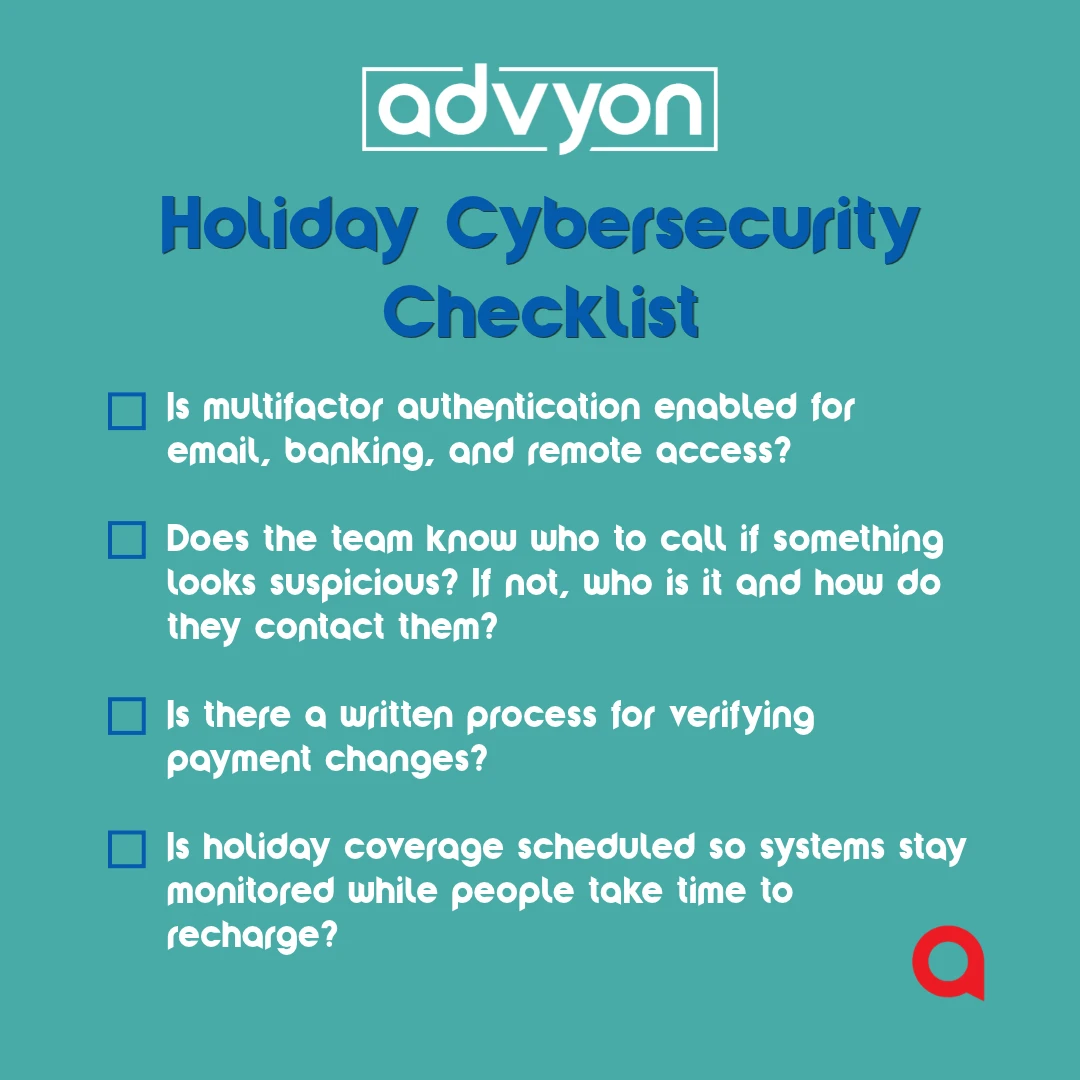
A quick holiday readiness check for leadership
- Is multifactor authentication enabled for email, banking, and remote access?
- Does the team know who to call if something looks suspicious? If not, who is it and how do they contact them?
- Is there a written process for verifying payment changes?
- Is holiday coverage scheduled so systems stay monitored while people take time to recharge?
How does ADVYON help businesses stay resilient through the holidays?
ADVYON helps businesses across Charleston, Summerville, and the Lowcountry build cyber resilience by connecting people, process, and technology into one coordinated strategy. We believe security works best when it is woven into how your business already operates.
Think of it like a spiderweb. Your email, devices, website, phones, cloud systems, and team are all connected. When one strand is strengthened, the whole structure becomes more stable. When they are managed separately, gaps form in between.
Our approach brings those strands together:
- Managed Security Services that provide continuous monitoring and rapid response, so someone is always keeping watch, including during the holidays.
- AI Social Engineering Defense that helps your team recognize and respond to modern, AI-driven scams with confidence.
- Security awareness training designed for real people with real workloads, practical and encouraging rather than overwhelming.
- Email threat detection and endpoint protection that help stop suspicious activity early.
- Backup and recovery planning so your business can get back to work quickly if something does go wrong.
Technology should empower your people, not intimidate them. Our role is to help you understand your current situation and provide a practical path forward for the year ahead.
PLAN AHEAD WITH ADVYON
Start the new year on a stronger foundation.
Contact ADVYON to schedule a conversation about your holiday readiness and your 2027 technology plan. We will help you understand your situation and develop a strategy that fosters growth, trust, and peace of mind.
Frequently Asked Questions
Quick answers to the holiday cybersecurity questions business owners and teams ask most.
What is the most common holiday scam targeting small businesses?
Fake invoices and payment change requests are among the most common. They often appear to come from a known vendor and ask for quick payment or updated banking details before year end.
Should employees ever buy gift cards based on an email request?
No gift card purchase should be made based on an email or text request alone. Confirm the request in person or by phone with the person who supposedly sent it.
How can I tell if a phone call from my boss is an AI voice clone?
You may not be able to tell by sound alone. The safest approach is to verify through a second channel, such as calling back on a known number or using a pre-agreed safe word for urgent requests.
What is business email compromise?
Business email compromise is a scam where someone impersonates a trusted contact, such as an executive or vendor, to trick employees into sending money or sensitive information.
What should an employee do if they clicked a suspicious link?
Report it right away to your IT provider or internal contact. Fast reporting helps contain the issue quickly, and it should always receive support, not blame.
Does a small business really need cybersecurity support during the holidays?
Yes. Holiday schedules reduce staffing while scam activity rises. Continuous monitoring and a clear response plan help keep your business protected while your team takes time to recharge.
What is cyber resilience?
Cyber resilience is a business’s ability to anticipate, withstand, respond to, and recover from cyber threats while continuing to operate.